
Creating Space for Thoughts We Don’t Normally Have: Cultivating Organisational Conditions for Resilient Work Life through DesignWISE
Text and photos by Lene Hald, PhD (Design Anthropology)

Introduction
Resilience is often understood as an individual capacity: the ability to withstand pressure, recover from disruption and adapt to change. Yet the concept originates in ecology, where resilience describes the capacity of living systems to absorb disturbance while maintaining the relationships and functions that sustain them (Holling, 1973; Folke, 2016).
Nature reminds us that resilience never emerges in isolation. A tree does not survive because of its strength alone but because it exists within a living web of soil organisms, fungi, water, biodiversity and reciprocal relationships (Mancuso & Viola, 2015).
Viewed through this ecological lens, resilient work life becomes more than an individual capacity to cope with uncertainty. It emerges through the relational, cultural, structural and material conditions in which people work together. This perspective raises an important methodological question: How might organisations intentionally cultivate such conditions?
Ida Engholm’s DesignWISE offers one possible way of approaching this question. Developed as a planetary design methodology, it operationalises Otto Scharmer’s concept of the social field; the quality of attention, relationships and awareness from which innovation and transformation emerge (Scharmer, 2018; Scharmer & Kaufer, 2025).
DesignWISE (Engholm et al., 2024) integrates reflection, presencing and cyclical movement between doing and being as constitutive dimensions of facilitated design practice. This article proposes that these qualities create a temporary social field for collective inquiry in which the relational and organisational conditions associated with resilient work life become visible and open to reflection.
Positioned at the intersection of design research, leadership and work-life studies, this article reflects on how a facilitated DesignWISE workshop creates a temporary social field in which organisational conditions for resilient work life can be cultivated.
2. From Individual Resilience to Relational Resilience
The growing interest in resilience reflects a broader shift in contemporary work life. Organisations are increasingly expected to navigate uncertainty, rapid technological change, climate transitions and shifting labour markets while simultaneously supporting employee wellbeing and innovation. In response, resilience has become a central concept within organisational development, leadership and entrepreneurship (Coutu, 2002; Sutcliffe & Vogus, 2003; Duchek, 2020).
Within organisational studies, resilience has often been associated with the ability to respond constructively to disruption and uncertainty. Coutu (2002) identifies three central characteristics of resilience: the capacity to confront reality, create meaning in challenging situations, and improvise with available resources. While this perspective expands resilience beyond simple endurance, more recent perspectives increasingly emphasise resilience as a dynamic and socially embedded process that develops through organisational practices, relationships and learning (Sutcliffe & Vogus, 2003; Duchek, 2020). This raises the question of how such capacities are cultivated and sustained within organisational life.
These ideas have recently entered design research through Engholm’s development of DesignWISE, which we in this article explore as a relational design methodology and innovation process that intentionally cultivates the social field from which resilient organisational practices may emerge.
Through a DesignWISE workshop the article explores question such as: What actually happens when experienced practitioners are invited into such a social field? How do leaders, entrepreneurs and business developers respond when the pace of everyday work is temporarily suspended in favour of collective reflection? What kinds of conversations become possible? Which tensions become visible? And how might these insights contribute to a richer understanding of resilient work life?
3. Exploring Resilient Work Life through DesignWISE
To explore these ideas through practice, an exploratory DesignWISE workshop was conducted bringing together practitioners representing different organisational positions: a CEO from a medium-sized engineering company, a business consultant from a local business development organisation, and a young entrepreneur developing her own business.
The workshop was facilitated by the author together with a colleague (Mette Day from Zealand Academy of Technologies and Business) and formed part of an ongoing research project exploring resilient work life.
The session took place in a circle with an invitation for reflection in the middle. The invitation deliberately framed the workshop as a shared exploration: “What needs more space in our ways of working?” Rather than seeking expert opinions about resilience, participants were invited to explore their own lived experiences of contemporary work life through the DesignWISE process.
https://planetarydreaming.org/designwise/
The DesignWISE process is structured as a cyclical sequence in which “phases oriented towards action are interwoven with phases that invite sensing, reflection, and reconsideration” (Engholm et al., 2024) allowing participants to engage with an issue through multiple perspectives and modes of attention. In this study the intention was to investigate what kinds of conversations, reflections and organisational insights emerged when participants were invited into a different rhythm of attention.
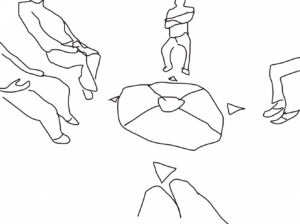
Partcipants gathered around the DesignWISE wheel.
It was structured around four seasonal movements inspired by the DesignWISE framework: Winter, Spring, Summer and Autumn. Each phase invited participants to engage with work life through a different quality of attention. The process began with Winter, where participants were invited to slow down, become present and reflect individually upon questions such as: What currently occupies most of your working life? Where do you experience conflicting demands?What do you need to let go of? During Spring, participants shifted towards sensing emerging needs within organisations: What needs are currently overlooked? What longs for more space in the way we work together? Summer invited participants to imagine alternative futures in which DesignWISE had already become part of everyday organisational practice: What is different now? while Autumn focused on translating these reflections into small speculative organisational experiments.The facilitation deliberately alternated between moments of silence, guided reflection and a final semi-structured group interview.
4. The DesignWISE engagement: Cultivating the Conditions for Resilient Work Life
Rather than generating immediate solutions to organisational challenges, the DesignWISE engagement created a social field in which participants reflected upon the conditions shaping their current work life. On their reflection cards and across the subsequent interview, participants repeatedly returned to four interconnected themes: Resistance towards unfamiliar ways of knowing, the need for organisational spaces of reflection, leadership’s role in legitimising these spaces, and the relationship between organisational tempo and resilience. Together, these themes suggest that resilience was understood less as an individual capability than as something emerging through organisational culture and relationships.
4.1 Resistance as a starting point for transformation
Perhaps the most immediate response concerned the presencing element of the workshop itself. Benni described being surprised by the role of meditation within the process: “What surprised me was this thing about meditation, or hypnosis, or whatever you want to call it. That it was actually the core of it.” Rather than dismissing the experience, however, his reflection quickly moved towards a broader organisational concern. He anticipated that such practices would challenge existing organisational norms: “There will definitely be some resistance to it. By certain people”.
Rather than understanding this resistance as an individual reaction or as a fixed characteristic of the organisation, we approach it here from an ecological and relational perspective. Resistance can therefore be understood not simply as something that participants bring with them into the workshop, but as something that emerges in the encounter between established ways of organising work and the practices introduced through DesignWISE. The presencing exercise, the invitation to slow down, the physical setting, the reflection cards, the language used to describe the process, and the participants’ embodied expectations of what constitutes legitimate work all participate in producing the situation.
From this perspective, the moment of surprise is analytically interesting because it makes an otherwise taken-for-granted organisational logic temporarily visible. Benni’s reference to meditation as something unexpected points to an implicit understanding of what belongs within a professional or organisational context and what does not. Practices associated with stillness, bodily awareness or inward reflection may sit uneasily alongside dominant expectations of efficiency, productivity and measurable outcomes. Resistance thus emerges at the encounter between different established notions of what work is, what counts as legitimate knowledge, and how professionals are expected to behave.
This resonates with the argument that knowledge is always situated rather than produced from a detached or neutral position. The workshop did not simply introduce participants to a new method; it repositioned them within a different set of relations and temporarily altered the conditions through which they could sense, reflect and speak about their work. What becomes visible in such a process is therefore not only the participant’s response to DesignWISE, but also something about the organisational conditions against which the practice encounters resistance.
4.2 “I did have a little aha moment.”
Importantly, resistance did not lead the participant to reject the method. On the contrary, later in the conversation, Benni reflected on its potential, noting: “I did have a little aha moment.” He explained that this “aha moment” arose as the method led him to consider how a presencing approach might shift organisational attention towards “…more focus on people rather than the hard business values that you would normally put first,” suggesting that the method not only generated new insight but also invited reflection on alternative organisational logics.
This movement from scepticism towards curiosity is analytically significant. It suggests that resistance can function as a point of contact between different ways of knowing and organising. Rather than treating resistance as evidence that the method fails, we understand it as a moment in which existing assumptions become perceptible because they encounter something that does not immediately fit.
Seen in this way, DesignWISE does not simply overcome resistance. It creates a social field in which existing organisational logics can be encountered, unsettled and potentially reconfigured. The value of the process therefore lies not in eliminating tension, but in making space for other relations to emerge. The workshop temporarily changed what could be attended to, talked about and valued, thereby creating a social field in which alternative understandings of work and organisational life could become thinkable.
4.3 Creating organisational space for emerging futures
Across all three participants, a second theme concerned the absence of reflection within everyday work life. Rather than describing reflection as a luxury, participants repeatedly connected it to the quality of organisational decision-making.
Vivi described the experience simply: “It gives you space for certain thoughts, allowing you to sit quietly and tune into how you feel.” Later, she connected this directly to the pace of organisational life: “I think everywhere people are working at full speed and forgetting that…” Returning to this theme, Benni added that the process would lead to working more “intuitively” and collaborating with “less conflict.”
Celina similarly highlighted that the questions themselves opened up reflections that are rarely invited within organisational life: “There were some good questions that you had to think about, things that you don’t normally think about.” She continued: “It’s about creating a space to get somewhere, and to think thoughts that you perhaps don’t normally have the time or space for.”
Taken together, these reflections point towards something that extends beyond individual wellbeing. Participants were not primarily asking for less work. Instead, they repeatedly articulated the need for organisational practices that legitimise slowing down sufficiently to enable shared reflection before acting. Rather than functioning as a pause from work, reflection emerged as an organisational capability in itself.
4.4 Leadership legitimises resilient practice
One of the clearest themes emerging across the interview concerned the role of leadership. Participants repeatedly emphasised that reflective spaces cannot be sustained through individual initiative alone. Rather, they require organisational legitimacy.
Reflecting on the possibility of introducing DesignWISE within her own organisation, Vivi explained: “It requires the leadership to be on board.” Without this support, she suggested, employees would quickly lose confidence in the process: “I think as an employee, you would just think: okay, we’re doing this again, but nothing will come of it anyway.” Rather than understanding reflection as an individual practice, participants therefore located responsibility within organisational leadership. Reflection required permission.
This theme reappeared later in the conversation when participants discussed how DesignWISE might realistically be introduced into organisational life. Rather than recommending large-scale organisational change, they proposed beginning with smaller experiments connected to existing organisational processes as a way of feeling “heard” and “included”.
Interestingly, participants did not frame these reflective spaces as alternatives to organisational decision-making. Rather, they imagined them as part of decision-making itself. Reflection became understood as a collective organisational practice that could precede important decisions rather than follow them. This finding resonates closely with Scharmer’s understanding of presencing as a movement that precedes action (2018; Scharmer & Kaufer, 2025). Rather than separating reflection from organisational performance, participants suggested that reflection might strengthen the quality of subsequent decisions by allowing organisations to pause before acting. In this sense, leadership becomes less a matter of directing action than of cultivating the conditions from which wiser action can emerge.
4.5 From efficiency towards relational resilience
The participants rarely spoke about resilience directly. Instead, they described characteristics of contemporary work life that appeared to undermine resilience: High tempo. Continuous decision-making. Documentation. Control. Lack of time for conversation.
Benni reflected that organisational life often becomes dominated by what he described as “hard” business values, while the workshop opened another perspective by reorienting attention towards “…more focus on people rather than the hard business values that you would normally put first.”
His reflection points to the relationship between inner transformation and outer organisational change. Scharmer argues that “the success of an intervention depends on the interior condition of the intervener” (Scharmer, 2009, p. 35), suggesting that transformation is shaped not only by what we do, but also by the quality of attention and awareness from which we act. From this perspective, resilient work life requires not only new organisational structures or strategies, but also spaces where new ways of caring, sensing, relating and responding can emerge.
Later in the discussion, Benni broadened this critique by arguing that much contemporary work no longer creates value but instead reproduces organisational complexity: “Much of the problem is what I call pseudo-work. We create work for each other… documentation, control and record-keeping.” He continued: “We create poor working conditions through all the systems and requirements that people have to deal with.”
Rather than discussing resilience as an individual psychological resource, participants repeatedly returned to these organisational structures as sources of pressure. The challenge was therefore not simply helping individuals cope with demanding work but reconsidering the organisational practices that continually generate overload.
Vivi expressed a similar concern while simultaneously speculating on preferred futures for her workplace, describing what another organisational culture driven by such processes might enable: “I think it would only create more space for creativity, capacity, joy, balance … co-creation.” Vivi continued by observing a broader cultural shift: “I don’t think our children will accept the same working life that we have had.”
Taken together, these reflections suggest that participants understood resilient work life less as increasing individuals’ capacity to tolerate existing organisational conditions and more as creating organisational cultures in which reflection, collaboration and human relationships become legitimate parts of everyday practice. Rather than positioning resilience as an outcome of stronger individuals, the conversations repeatedly pointed towards resilience as an emergent quality of organisational life itself.
5. Discussion: Resilience as an Organisational Condition
This study invites reflection on how resilience might be understood differently when approached through an ecological rather than an individual lens. Here, ecology refers not only to environmental concerns, but to resilience as emerging through relationships among people, organisations and wider living systems.
Rather than emphasising employees’ capacity to cope with uncertainty, the findings suggest that resilience depends on cultivating the organisational conditions in which people work. Participants consistently highlighted the importance of reflection, dialogue, leadership and organisational culture over individual coping strategies.
These findings support an ecological understanding of resilience (Holling, 1973; Folke, 2016) and resonate with Scharmer’s concept of the social field. Rather than positioning resilience as an individual competency, the workshop suggests that resilience is closely connected to the quality of relationships, attention and organisational conditions. In this sense, DesignWISE serves less as a tool for producing resilience than as a facilitated inquiry that temporarily creates a social field in which these conditions become visible, discussable and open to reflection.
Participants’ initial resistance towards meditation and reflective practices is also significant. Rather than indicating that the method was ineffective, this resistance exposed dominant assumptions about work, where speed, efficiency and measurable outcomes define what counts as legitimate practice. By temporarily interrupting these routines, DesignWISE opened space for alternative ways of reflecting, relating and organising.
Overall, the study suggests that resilience is less an individual capability than an organisational capacity to cultivate the relational conditions that enable collective reflection, learning and adaptive action in situations of uncertainty.

6. Conclusion
This exploratory study does not seek to generalise its findings. Based on a single DesignWISE workshop, its contribution is instead conceptual and methodological. It explores how resilience in contemporary work life might be understood differently when viewed through an ecological lens.
Rather than locating resilience within the individual, the findings suggest that resilience emerges through relationships, organisational cultures and the conditions in which people work together. Participants did not ask for fewer challenges. Instead, they pointed to the need for more space for reflection, dialogue and collective sensemaking.
In botanical terms, to cultivate means to prepare the conditions for growth. A plant is not resilient because of its own strength alone, but because of the ecosystem in which it grows. Likewise, resilient organisations may depend less on resilient individuals and more on leaders who cultivate environments where trust, reflection and new ways of working can emerge.
DesignWISE offers a facilitated inquiry that temporarily creates a social field in which participants can reflect on, articulate and question the organisational conditions from which resilient work life may emerge.

References
Coutu, D. L. (2002). How resilience works. Harvard Business Review, 80(5), 46–55.
Duchek, S. (2020). Organizational resilience: A capability-based conceptualization. Business Research, 13(1), 215–246
Engholm, I. (2023). Design for the new world: From human design to planet design. Intellect Books.
Engholm, I., Borg, L., Frandsen, B., Funder, C., & Melchiorsen, H. (2024). DesignWISE: At skabe uden at skade. Planetary Dreaming.
Folke, C. (2016). Resilience (republished). Ecology and Society, 21(4), Article 44.
Holling, C. S. (1973). Resilience and stability of ecological systems. Annual Review of Ecology and Systematics, 4, 1–23.
Mancuso, S., & Viola, A. (2015). Brilliant green: The surprising history and science of plant intelligence. Island Press.
Scharmer, C. O. (2018). The essentials of Theory U: Core principles and applications. Berrett-Koehler Publishers.
Scharmer, C. O., & Kaufer, K. (2025). Presencing: 7 practices for transforming self, society, and business. Berrett-Koehler Publishers.
Sutcliffe, K. M., & Vogus, T. J. (2003). Organizing for resilience. In K. Cameron, J. Dutton & R. Quinn (Eds.), Positive Organizational Scholarship (pp. 94–110). Berrett-Koehler.


